Footprints in the snow have been unfailing provokers of sentiment ever since snow was first a white wonder in this drab-coloured world of ours. In a poetry-book presented to one of us by an aunt, there was a poem by one Wordsworth, in which they stood out strongly—with a picture all to themselves, too—but we didn't think very highly either of the poem or the sentiment. Footprints in the sand, now, were quite another matter, and we grasped Crusoe's attitude of mind much more easily than Wordsworth's. Excitement and mystery, curiosity and suspense—these were the only sentiments that tracks, whether in sand or in snow, were able to arouse in us.
We had awakened early that winter morning, puzzled at first by the added light that filled the room. Then, when the truth at last fully dawned on us and we knew that snow-balling was no longer a wistful dream, but a solid certainty waiting for us outside, it was a mere brute fight for the necessary clothes, and the lacing of boots seemed a clumsy invention, and the buttoning of coats an unduly tedious form of fastening, with all that snow going to waste at our very door.
When dinner-time came we had to be dragged in by the scruff of our necks. The short armistice over, the combat was resumed; but presently Charlotte and I, a little weary of contests and of missiles that ran shudderingly down inside one's clothes, forsook the trampled battle-field of the lawn and went exploring the blank virgin spaces of the white world that lay beyond. It stretched away unbroken on every side of us, this mysterious soft garment under which our familiar world had so suddenly hidden itself. Faint imprints showed where a casual bird had alighted, but of other traffic there was next to no sign; which made these strange tracks all the more puzzling.
We came across them first at the corner of the shrubbery, and pored over them long, our hands on our knees. Experienced trappers that we knew ourselves to be, it was annoying to be brought up suddenly by a beast we could not at once identify.
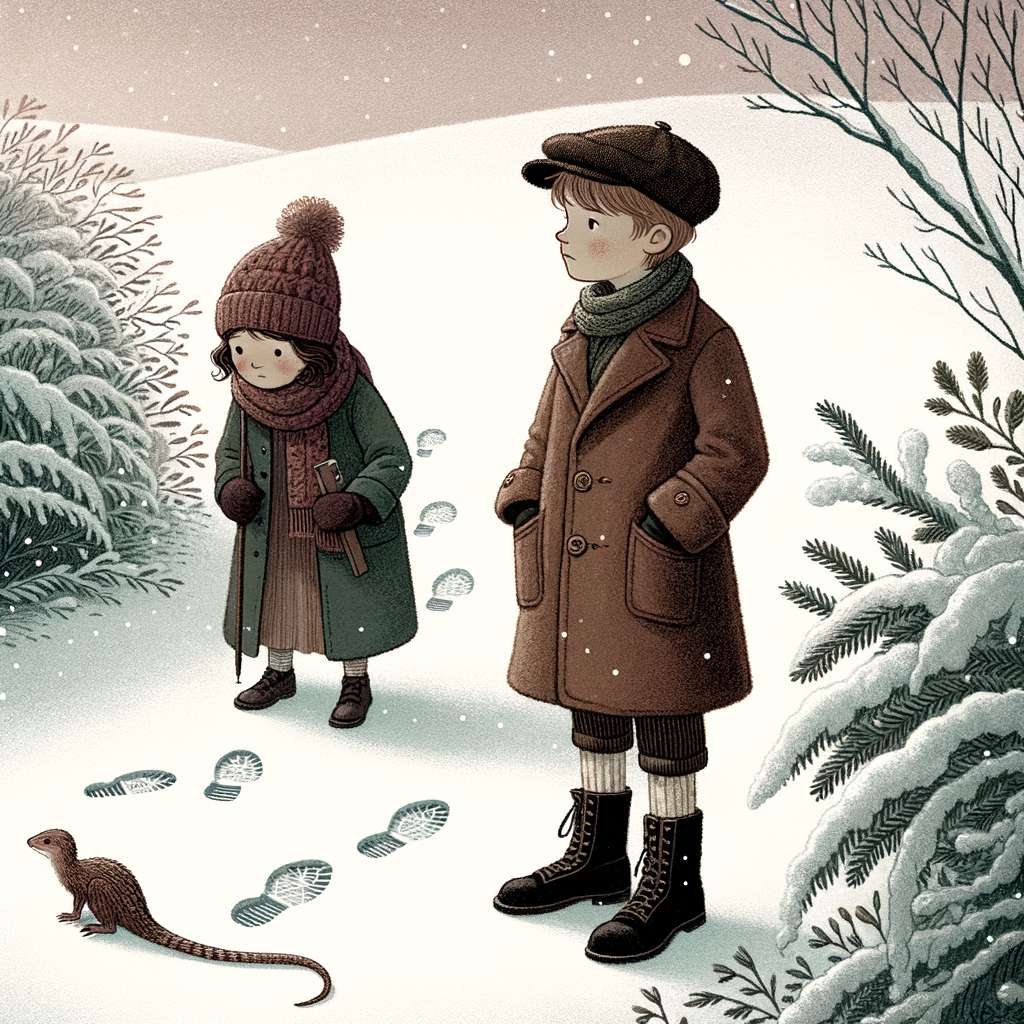
"Don't you know?" said Charlotte, rather scornfully. "Thought you knew all the beasts that ever was."
This put me on my mettle, and I hastily rattled off a string of animal names embracing both the arctic and the tropic zones, but without much real confidence.
"No," said Charlotte, on consideration; "they won't any of 'em quite do. Seems like something lizardy. Did you say a iguanodon? Might be that, p'raps. But that's not British, and we want a real British beast. I think it's a dragon!"
"'Tisn't half big enough," I objected.
"Well, all dragons must be small to begin with," said Charlotte: "like everything else. P'raps this is a little dragon who's got lost. A little dragon would be rather nice to have. He might scratch and spit, but he couldn't do anything really. Let's track him down!"
So we set off into the wide snow-clad world, hand in hand, our hearts big with expectation,—complacently confident that by a few smudgy traces in the snow we were in a fair way to capture a half-grown specimen of a fabulous beast.
We ran the monster across the paddock and along the hedge of the next field, and then he took to the road like any tame civilised taxpayer. Here his tracks became blended with and lost among more ordinary footprints, but imagination and a fixed idea will do a great deal, and we were sure we knew the direction a dragon would naturally take. The traces, too, kept reappearing at intervals—at least Charlotte maintained they did, and as it was her dragon I left the following of the slot to her and trotted along peacefully, feeling that it was an expedition anyhow and something was sure to come out of it.
Charlotte took me across another field or two, and through a copse, and into a fresh road; and I began to feel sure it was only her confounded pride that made her go on pretending to see dragon-tracks instead of owning she was entirely at fault, like a reasonable person. At last she dragged me excitedly through a gap in a hedge of an obviously private character; the waste, open world of field and hedgerow disappeared, and we found ourselves in a garden, well-kept, secluded, most undragon-haunted in appearance. Once inside, I knew where we were. This was the garden of my friend the circus-man, though I had never approached it before by a lawless gap, from this unfamiliar side. And here was the circus-man himself, placidly smoking a pipe as he strolled up and down the walks. I stepped up to him and asked him politely if he had lately seen a Beast.
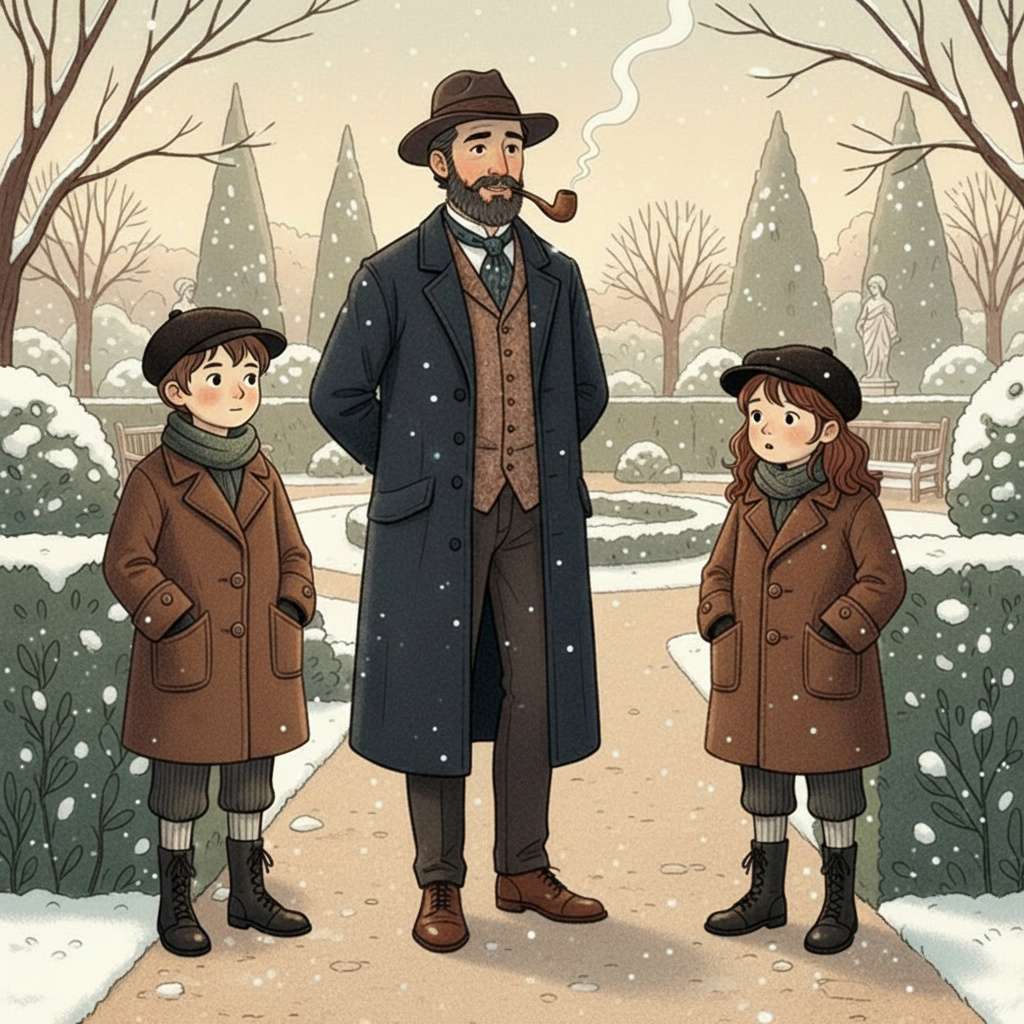
"May I inquire," he said, with all civility, "what particular sort of a Beast you may happen to be looking for?"
"It's a lizardy sort of Beast," I explained. "Charlotte says it's a dragon, but she doesn't really know much about beasts."
The circus-man looked round about him slowly. "I don't think," he said, "that I've seen a dragon in these parts recently. But if I come across one I'll know it belongs to you, and I'll have him taken round to you at once."
"Thank you very much," said Charlotte, " but don't trouble about it, please, 'cos p'raps it isn't a dragon, after all. Only I thought I saw his little footprints in the snow, and we followed 'em up, and they seemed to lead right in here, but maybe it's all a mistake, and thank you all the same."
"Oh, no trouble at all," said the circus-man, cheerfully. "I should be only too pleased. But of course, as you say, it may be a mistake. And it's getting dark, and he seems to have got away for the present, whatever he is. You'd better come in and have some tea. I'm quite alone, and we'll make a roaring fire, and I've got the biggest Book of Beasts you ever saw. It's got every beast in the world, and all of 'em coloured; and we'll try and find your beast in it!"
We were always ready for tea at any time, and especially when combined with beasts. There was marmalade, too, and apricot-jam, brought in expressly for us; and afterwards the beast-book was spread out, and, as the man had truly said, it contained every sort of beast that had ever been in the world.
The striking of six o'clock set the more prudent Charlotte nudging me, and we recalled ourselves with an effort from Beastland, and reluctantly stood up to go.
"Here, I'm coming along with you," said the circus-man. "I want another pipe, and a walk'll do me good. You needn't talk to me unless you like."
Our spirits rose to their wonted level again. The way had seemed so long, the outside world so dark and eerie, after the bright warm room and the highly-coloured beast-book. But a walk with a real Man—why, that was a treat in itself! We set off briskly, the Man in the middle. I looked up at him and wondered whether I should ever live to smoke a big pipe with that careless sort of majesty! But Charlotte, whose young mind was not set on tobacco as a possible goal, made herself heard from the other side.
"Now, then," she said, "tell us a story, please, won't you?"
The Man sighed heavily and looked about him. "I knew it," he groaned. "I knew I should have to tell a story. Oh, why did I leave my pleasant fireside? Well, I will tell you a story. Only let me think a minute."
So he thought a minute, and then he told us this story.
Long ago—might have been hundreds of years ago—in a cottage half-way between this village and yonder shoulder of the Downs up there, a shepherd lived with his wife and their little son. Now the shepherd spent his days—and at certain times of the year his nights too—up on the wide ocean-bosom of the Downs, with only the sun and the stars and the sheep for company, and the friendly chattering world of men and women far out of sight and hearing. But his little son, when he wasn't helping his father, and often when he was as well, spent much of his time buried in big volumes that he borrowed from the affable gentry and interested parsons of the country round about. And his parents were very fond of him, and rather proud of him too, though they didn't let on in his hearing, so he was left to go his own way and read as much as he liked; and instead of frequently getting a cuff on the side of the head, as might very well have happened to him, he was treated more or less as an equal by his parents, who sensibly thought it a very fair division of labour that they should supply the practical knowledge, and he the book-learning. They knew that book-learning often came in useful at a pinch, in spite of what their neighbours said. What the Boy chiefly dabbled in was natural history and fairy-tales, and he just took them as they came, in a sandwichy sort of way, without making any distinctions; and really his course of reading strikes one as rather sensible.
One evening the shepherd, who for some nights past had been disturbed and preoccupied, and off his usual mental balance, came home all of a tremble, and, sitting down at the table where his wife and son were peacefully employed, she with her seam, he in following out the adventures of the Giant with no Heart in his Body, exclaimed with much agitation:
"It's all up with me, Maria! Never no more can I go up on them there Downs, was it ever so!"
"Now don't you take on like that," said his wife, who was a very sensible woman: "but tell us all about it first, whatever it is as has given you this shake-up, and then me and you and the son here, between us, we ought to be able to get to the bottom of it!"
"It began some nights ago," said the shepherd. "You know that cave up there—I never liked it, somehow, and the sheep never liked it neither, and when sheep don't like a thing there's generally some reason for it. Well, for some time past there's been faint noises coming from that cave—noises like heavy sighings, with grunts mixed up in them; and sometimes a snoring, far away down—real snoring, yet somehow not honest snoring, like you and me o' nights, you know!"
"I know," remarked the Boy, quietly.
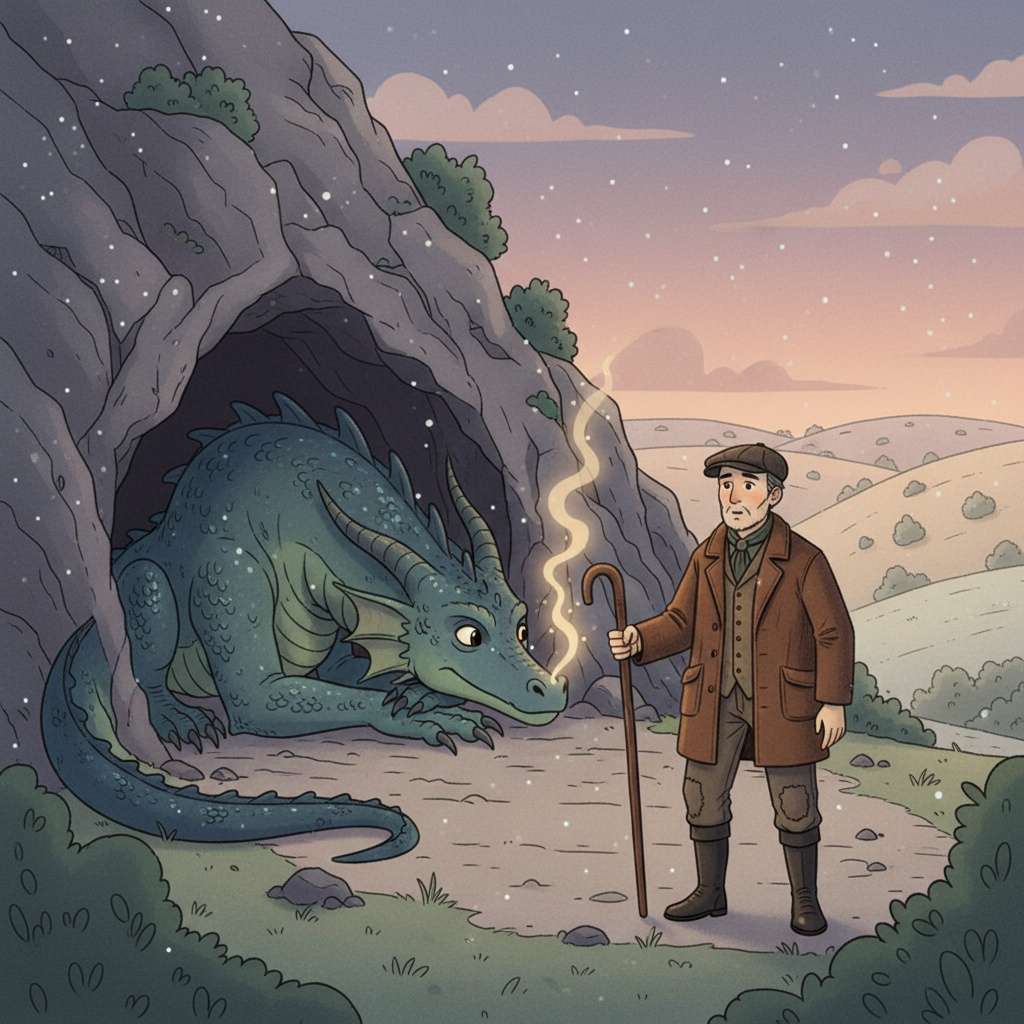
"Of course I was terrible frightened," the shepherd went on; "yet somehow I couldn't keep away. So this very evening, before I come down, I took a cast round by the cave, quietly. And there—O Lord! there I saw him at last, as plain as I see you!"
"Saw who?'' said his wife, beginning to share in her husband's nervous terror.
"Why him, I'm a telling you!" said the shepherd. "He was sticking half-way out of the cave, and seemed to be enjoying of the cool of the evening in a poetical sort of way. He was as big as four cart-horses, and all covered with shiny scales—deep-blue scales at the top of him, shading off to a tender sort o' green below. As he breathed, there was that sort of flicker over his nostrils that you see over our chalk roads on a baking windless day in summer. He had his chin on his paws, and I should say he was meditating about things. Oh, yes, a peaceable sort o' beast enough, and not ramping or carrying on or doing anything but what was quite right and proper. I admit all that. And yet, what am I to do? Scales, you know, and claws, and a tail for certain, though I didn't see that end of him—I ain't used to 'em, and I don't hold with 'em, and that's a fact!"